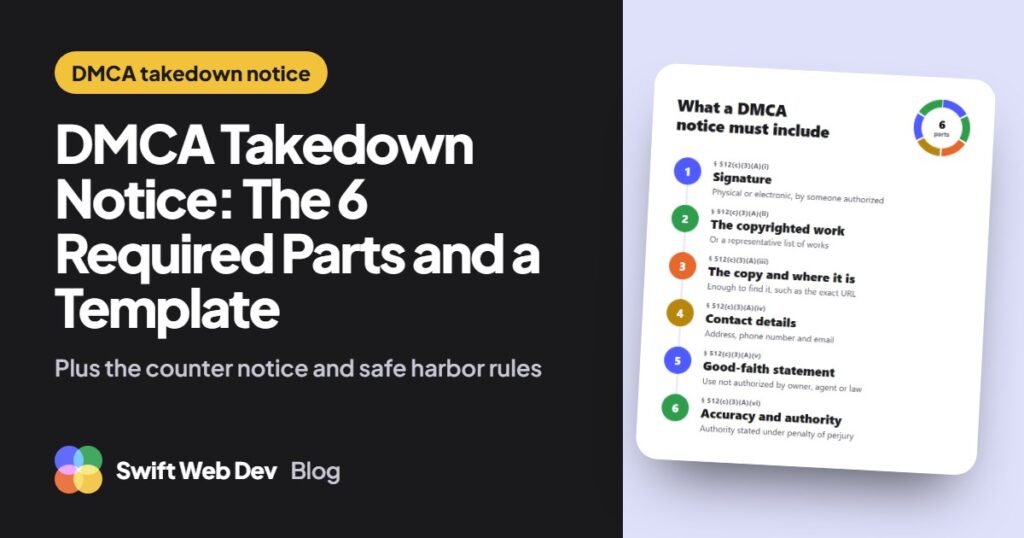
A DMCA takedown notice is a written request, sent to a website’s designated copyright agent, to remove material that infringes your copyright. To count under the law, it must include the six things listed in 17 U.S.C. § 512(c)(3)(A): a signature, the copyrighted work, the infringing material and where it is, your contact details, a good-faith statement, and a statement that the notice is accurate and, under penalty of perjury, that you may act for the copyright owner.
This guide covers both sides: sending a notice, with a template, and handling one as a site owner. I read section 512 line by line while adding a copyright form to my own WordPress plugin, and every rule below links back to the statute or the US Copyright Office. It’s a plain-English summary, not legal advice.
What is a DMCA takedown notice?
The DMCA is the Digital Millennium Copyright Act, which Congress passed in 1998. Its section 512 set up the notice-and-takedown system: a copyright owner tells a website about infringing material, and the site removes it. In return, a site that follows the rules gets a “safe harbor” from money damages over what its users store there.
A DMCA notice, DMCA complaint, DMCA takedown request and DMCA letter all mean the same document, which the law calls a “notification of claimed infringement.”
The six parts a DMCA notice must include
The statute says a notice must be “a written communication provided to the designated agent of a service provider” that includes “substantially the following.” Here are the six parts, quoted from 17 U.S.C. § 512(c)(3)(A):
- Signature. “A physical or electronic signature of a person authorized to act on behalf of the owner of an exclusive right that is allegedly infringed.”
- The work. “Identification of the copyrighted work claimed to have been infringed.” If one site copies many of your works, a representative list is enough.
- The copy and where it is. “Identification of the material that is claimed to be infringing … and information reasonably sufficient to permit the service provider to locate the material.” In practice, the exact URL of each page or file.
- Contact details. “Information reasonably sufficient to permit the service provider to contact the complaining party,” such as an address, phone number and email.
- Good-faith statement. “A statement that the complaining party has a good faith belief that use of the material in the manner complained of is not authorized by the copyright owner, its agent, or the law.”
- Accuracy and authority. “A statement that the information in the notification is accurate, and under penalty of perjury, that the complaining party is authorized to act on behalf of the owner of an exclusive right that is allegedly infringed.”
Read the sixth part closely: the words “under penalty of perjury” sit with the claim that you may act for the owner.
A notice that falls well short of these parts doesn’t count as putting the site on notice, with one exception: if it still identifies the work, the copy and its location, and the sender’s contact details, the site keeps that benefit only if it promptly tries to contact the sender or takes other reasonable steps to get a complete notice.
DMCA takedown notice template
Fill in the brackets and send one notice per site. It works as a general copyright takedown notice template too. Keep the two statements near the end as written: they use the statute’s words.
Subject: DMCA takedown notice

To: [Agent name], designated agent for [site or company name]

I am writing to report material on your service that infringes a copyright [I own / held by my client, (owner's name)].

1. Copyrighted work: [Title and short description of the original work, with a link to where the owner published it, if it is online.]

2. Infringing material and its location: [The exact URL of each page or file to be removed, and what on that page is copied, for example "the second photo in the post".]

3. Contact details: [Full name, postal address, phone number, email address.]

4. Good-faith statement: I have a good faith belief that use of the material in the manner complained of is not authorized by the copyright owner, its agent, or the law.

5. Accuracy and authority: The information in this notification is accurate, and under penalty of perjury, I am authorized to act on behalf of the owner of an exclusive right that is allegedly infringed.

Signature: [Your full name, typed or signed]
[Your title and company, if you act for the owner]
Date: [Date]
How to send a DMCA takedown request
- Find the designated agent. Search the US Copyright Office’s DMCA Designated Agent Directory by the site’s or company’s name. Also check the site’s footer for a DMCA or copyright page, since the safe harbor rules ask sites to publish the agent’s details too.
- Use the site’s form if it has one, or email the agent. List every URL in one notice per site.
- Try the host if no agent is listed. Search the directory for the site’s hosting company, which is a service provider too.
- Keep records of the notice, the date you sent it and every reply.
Only send a notice for a work you own or may act for. The good-faith statement covers uses “authorized by the law,” which includes fair use, so consider whether the use might be fair before you send. A false notice can cost you (see 512(f) below).
DMCA forms on YouTube, Instagram, Facebook, X, Shopify and Amazon
Large platforms have their own copyright forms:
- YouTube: YouTube’s copyright removal request
- Instagram and Facebook: Meta’s intellectual property reporting form, where you choose Copyright
- X (Twitter): X’s intellectual property form
- Shopify stores: Shopify’s copyright infringement notice
- Amazon listings: Amazon’s Report Infringement form, after you sign in
Received a DMCA notice? What a site owner must do
The safe harbor in section 512(c) covers material your users store on your site, such as comments, forum posts and uploads, not what you publish yourself. If your site holds user content, follow this routine:
- Check the six parts. If some are missing, reply promptly and ask for the rest.
- Remove it or block access, expeditiously. The statute says “expeditiously” and stops there. It sets no number of hours or days. Pick a target your team can always meet, and log when each notice arrived and when you acted.
- Tell the person who posted it. Section 512(g) shields you from claims over a good-faith takedown, but for material a user stored, that depends on taking “reasonable steps promptly to notify” them and following the counter notice steps below.
- Track repeat infringers. The safe harbor needs a repeat infringer policy, and you can’t apply one without knowing which accounts received notices.
The safe harbor doesn’t depend on monitoring your site. You act on notices, and on infringement you know about or that is apparent from the facts.
The DMCA counter notice
A counter notice is how the user whose material came down pushes back. Under section 512(g)(3), it goes in writing to the site’s designated agent and includes four parts:
- The user’s physical or electronic signature.
- The material that was removed and where it appeared before removal.
- A statement under penalty of perjury that the user believes in good faith it was removed “as a result of mistake or misidentification.”
- The user’s name, address and phone number, consent to the jurisdiction of the federal district court for that address (or any district where the site can be found, if the user lives outside the US), and agreement to accept service of process from the person who sent the notice.
The site promptly sends a copy to the person who filed the takedown, says the material will be back in 10 business days, and restores it “not less than 10, nor more than 14, business days” after receiving the counter notice, unless the sender first tells the designated agent they have filed a court action against the user.
| Detail | Takedown notice | Counter notice |
|---|---|---|
| Who sends it | The copyright owner or someone authorized | The user whose material was removed |
| Section | 512(c)(3)(A) | 512(g)(3) |
| Required parts | Six | Four |
| Under penalty of perjury | Authority to act for the owner | Good-faith belief of mistake or misidentification |
| Sent to | The site’s designated agent | The site’s designated agent |
| What the site does | Removes or disables access expeditiously and tells the user | Forwards a copy, then restores in 10 to 14 business days unless told of a lawsuit |
DMCA agent registration: cost and renewal
The 512(c) safe harbor applies only if you have designated an agent to receive notices. You publish the agent’s contact details on your site where the public can reach them, and file them through the Copyright Office’s online DMCA agent registration system.
- What you file: your full legal name, physical street address (not a post office box) and any other names people might search for, plus the agent’s name, organization, mailing address, phone number and email.
- Fee: $6 per designation, amendment or resubmission today. The Copyright Office’s new fee schedule raises it to $25 on January 5, 2027.
- Renewal: a designation expires three years after it’s registered unless you amend or resubmit it, which starts a new three-year period. There’s no separate renewal fee beyond that amendment or resubmission fee.
DMCA safe harbor: the conditions
For what users store on your site, section 512 shields you from money damages for infringement, and limits court orders against you, if you meet all of these conditions:
- You don’t know the material infringes and aren’t aware of facts that make it apparent, and once you do, you act expeditiously.
- You get no financial benefit directly attributable to the infringing activity, where you have the right and ability to control it.
- You have a designated agent, published on your site and registered with the Copyright Office, and you respond expeditiously to valid notices.
- You have adopted and reasonably implemented a policy of ending repeat infringers’ accounts “in appropriate circumstances,” and you tell your users about it.
- You accommodate, and don’t interfere with, “standard technical measures” that copyright owners use to identify or protect their works.
Small sites tend to skip the repeat infringer policy. You need a written policy your users can read and a record of notices per account to apply it.
False notices: liability under 512(f)
Section 512(f) works both ways. Anyone who “knowingly materially misrepresents” that material is infringing, or that it was removed by mistake, is liable for damages, including costs and attorneys’ fees, to whoever is injured because a site relied on that claim. That covers a fake takedown notice and a false counter notice alike.
Handling DMCA notices on a WordPress site
On WordPress, a page naming your agent, a contact form and a spreadsheet can cover all of this. The weak spots: a notice nobody sees for a week, no record of when you acted, and an agent registration that quietly expires.
I built the copyright side of my free plugin, Takedown Desk on WordPress.org, around those weak spots. In version 1.1.0, the “Accept copyright notices” setting adds a DMCA takedown notice form that asks for the six parts of 512(c)(3)(A), on its own page with a footer link. Notices land in one inbox with a target you set in business days (1 to 10, 2 by default) and reminders before it runs out. Removal takes one step, the sender hears the outcome, and everything goes into a dated record. Enter the date you registered your agent, and it reminds you before the three-year renewal.
Counter notices aren’t part of this version, so those still go to your agent by email. The Takedown Desk plugin page has the download, and the copyright notices setup guide walks through the DMCA form. A plugin gives you the process. It doesn’t make your site compliant on its own.
DMCA vs the Take It Down Act
A DMCA notice is about copyright and comes from whoever owns the work. A Take It Down Act request is about intimate images shared without consent and comes from the person in the image or someone acting for them.
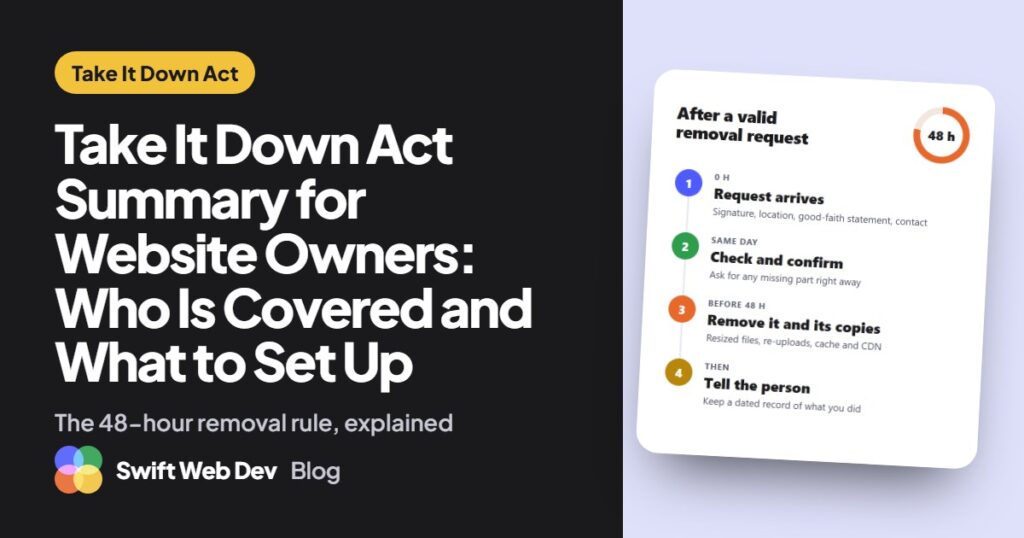
- Deadline: the DMCA says “expeditiously” with no hour count. The Take It Down Act says no later than 48 hours after a valid request.
- Pushing back: the DMCA has the counter notice. The Take It Down Act has no counter-notice step.
- Enforcement: a site that skips the DMCA steps loses the safe harbor’s protection. The Take It Down Act is enforced by the FTC, with civil penalties.
If your site takes user uploads, you may need both processes. My Take It Down Act summary for website owners covers the second one.
DMCA questions people ask
What is a DMCA?
The Digital Millennium Copyright Act, a 1998 US law. “Send them a DMCA” means sending a takedown notice under its notice-and-takedown system.
How long does a website have to act on a DMCA notice?
The law says “expeditiously” and gives no hour count. Set a target you can always meet and log when you acted.
Do I need a lawyer to send a DMCA takedown notice?
The law doesn’t require one. The owner or someone authorized to act for them signs it and states that authority under penalty of perjury. For contested cases, a lawyer is worth it.
Is this legal advice?
No. It’s a plain-English summary of section 512 and the Copyright Office’s rules as of November 2026. For your own case, talk to a lawyer.
Sources
- 17 U.S.C. § 512 (Cornell LII)
- The Digital Millennium Copyright Act (US Copyright Office)
- DMCA Designated Agent Directory FAQ (US Copyright Office)
- 37 CFR § 201.38, designation of agent (Cornell LII)
- Fee study 2026 final rule (US Copyright Office)