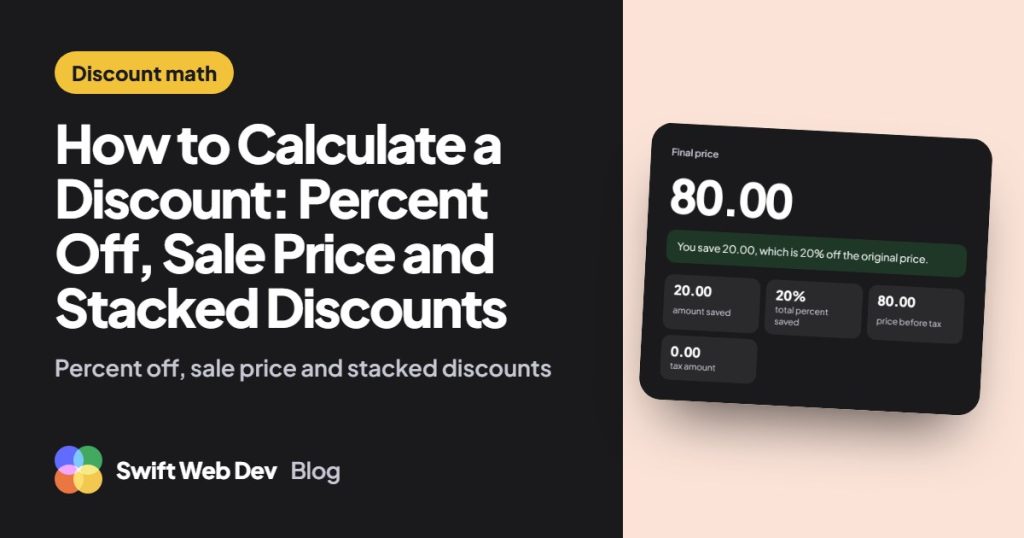
To calculate a discount, multiply the original price by the percent off and divide by 100. That gives you the amount you save. Subtract it from the original price and you have the sale price. For 25% off $80, you save 80 × 25 ÷ 100 = $20 and pay $60.
That one sum covers most sale tags. The rest of this post covers the cases that trip people up: working out the percent from two prices, finding the original price, stacked discounts and sales tax. I built the discount calculator on this site and checked it against hand-worked answers, so every example below has been done the long way.
The discount formula
There are two ways to write it. Both give the same answer.
- Amount saved = Original price × Percent off ÷ 100
- Sale price = Original price × (1 – Percent off ÷ 100)
The second version is quicker because it skips the subtraction. 15% off means you pay 85% of the price, so you multiply by 0.85.
Take a pair of shoes at $64 with 15% off:
- Amount saved: 64 × 15 ÷ 100 = $9.60.
- Sale price: 64 – 9.60 = $54.40.
- Or in one step: 64 × 0.85 = $54.40.
How to calculate percentage off without a calculator
You rarely need exact arithmetic in a shop. Four shortcuts cover most price tags, and they all start from 10%.
- 10% off. Move the decimal point one place to the left. 10% of $64 is $6.40.
- 20% off. Find 10% and double it. 6.40 × 2 = $12.80.
- 15% off. Find 10%, then add half of it. 6.40 + 3.20 = $9.60.
- 25% off. Halve the price twice. Half of 64 is 32, half of 32 is $16.
Subtract the result from the price and you’re done. For 30% or 40% off, take 10% and multiply by 3 or 4. For 5% off, take half of 10%.
So what is 20 percent off? It’s one fifth of the price removed. You pay 80% of the original. On a $45 shirt, 10% is $4.50, so 20% is $9 and the sale price is $36.
Percent off chart for common prices
The table shows the sale price, not the saving. Find the original price on the left and read across.
| Original price | 10% off | 20% off | 25% off | 30% off | 50% off |
|---|---|---|---|---|---|
| $20 | $18 | $16 | $15 | $14 | $10 |
| $50 | $45 | $40 | $37.50 | $35 | $25 |
| $80 | $72 | $64 | $60 | $56 | $40 |
| $100 | $90 | $80 | $75 | $70 | $50 |
| $250 | $225 | $200 | $187.50 | $175 | $125 |
For a price that isn’t in the table, type it into the percent off calculator and the answer updates as you type.
How to calculate the discount percentage between two prices
Sometimes the tag shows a “was” price and a “now” price and leaves the percent out. Take the difference and divide it by the original price.
Percent off = (Original price – Sale price) ÷ Original price × 100
What percent off is 45 from 60? The difference is 15, and 15 ÷ 60 = 0.25, so it’s 25% off. What percent off is 35 from 50? The difference is 15 again, but 15 ÷ 50 = 0.30, so that one is 30% off.
The common mistake is dividing by the sale price. 15 ÷ 45 gives 33.3%, which is wrong. A discount is always a share of the price you started with.
How to calculate a discount backwards to find the original price
If you know what you paid and the percent off, divide the sale price by what’s left after the discount.
Original price = Sale price ÷ (1 – Percent off ÷ 100)
You paid $60 after 25% off. You paid 75% of the original, so the original price was 60 ÷ 0.75 = $80. If you paid $68 after 15% off, the original was 68 ÷ 0.85 = $80.
Don’t add the percentage back on. 25% of $60 is $15, and 60 + 15 = $75, which is $5 short. The 25% came off the bigger number, so it can’t be put back using the smaller one.
Stacked discounts: why 20% then 10% is 28%, not 30%
A double discount doesn’t add up the way it looks. The second discount applies to a price that is already lower, so it takes off less.
Start with $100. Take 20% off and it’s $80. The extra 10% is 10% of 80, which is $8, not $10. You pay $72. That’s 28% off in total.
To combine two discounts into one, multiply what’s left after each:
Total percent off = (1 – (1 – D1 ÷ 100) × (1 – D2 ÷ 100)) × 100
For 20% and 10%, that’s 0.80 × 0.90 = 0.72, so you pay 72% and save 28%. A jacket at $80 with 25% off and a 10% coupon works the same way: 80 × 0.75 = $60, then 60 × 0.90 = $54. You save $26, which is 32.5% off, not 35%.
The order doesn’t matter. 10% then 20% lands on the same price as 20% then 10%, because you’re multiplying the same numbers. If a shop offers three in a row, such as a sale price, a coupon and a member offer, the discount calculator takes up to three discounts and shows the real total percent saved.
How to calculate discount and tax
In most shop sales, the discount comes off first and sales tax is added to the reduced price. So you work out the sale price, then multiply by 1 plus the tax rate.
Final price = Sale price × (1 + Tax ÷ 100)
Carry on with the jacket. The price after both discounts is $54 and sales tax is 8%:
- Tax: 54 × 0.08 = $4.32.
- Final price: 54 + 4.32 = $58.32.
Don’t subtract the tax rate from the discount. 25% off with 8% tax is not 17% off. On an $80 item, 25% off is $60, and 60 × 1.08 = $64.80. Taking 17% off $80 would give $66.40.
Tax rules differ by place and by type of coupon, so if your receipt doesn’t match, the receipt wins.
How to calculate a discount in Excel or Google Sheets
The same formulas work in both. Put the original price in A2 and the percent off in B2, typed as 25%. If you type 25 without the percent sign, use B2/100 in place of B2.
Sale price and amount saved:
=A2*(1-B2)
=A2*B2
With 80 in A2 and 25% in B2, those return 60 and 20.
Percent off from two prices, with the sale price in C2. Format the cell as a percentage:
=(A2-C2)/A2Original price from a sale price in C2 and a percent off in B2:
=C2/(1-B2)Two discounts in a row plus sales tax, with the second discount in D2 and the tax rate in E2, rounded to cents:
=ROUND(A2*(1-B2)*(1-D2)*(1+E2),2)With 80, 25%, 10% and 8%, that returns 58.32, the same as the jacket above. Microsoft’s page on the ROUND function explains the second argument if you need a different number of decimals.
Questions people ask about calculating discounts
20 percent off is how much?
One fifth of the price. Find 10% by moving the decimal point one place left, then double it. On $50 that’s $10 off, so you pay $40. On $45 it’s $9 off, so you pay $36.
How do I calculate a discount without the original price?
You need the sale price and the percent off. Divide the sale price by 1 minus the discount as a decimal. If you paid $60 after 25% off, the original price was 60 ÷ 0.75 = $80, and the discount was worth $20.
How do you calculate successive discounts?
Apply them one at a time, each to the price left by the one before. Or multiply what remains after each: 20% then 10% is 0.80 × 0.90 = 0.72, so you pay 72% of the original. That’s 28% off, never the two numbers added together.
Is a discount calculated before tax or after?
Usually before. The shop takes the discount off first, then adds sales tax to the lower price, which also means you pay less tax. Some places treat certain coupons differently, so check the receipt.
What is the formula to calculate a discount percentage?
Subtract the sale price from the original price, divide by the original price and multiply by 100. From $60 down to $45 is 15 ÷ 60 × 100 = 25%.
If you’d rather skip the arithmetic, the free discount calculator handles up to three discounts and sales tax in one go. If the sale has a deadline, the days between dates tool counts how long you have left. And if you need a calculator like this on your own website, Swift Web Dev builds custom calculators and WordPress sites. Start a discussion and tell me what you have in mind.